
Bittersweet
Invasion, belonging, and interspecies settler relationships


This piece is part of a new series: a collaboration between me and my beloved friend Julia of Apocalypse Musings. A while back, Julia was questioning their place in radical movement building, wondering what gifts they had to offer. I told them that their gift is reverence for the world. I meant it. Julia has taught me most of what I know about paying devoted attention to the living world. As soon as I started writing this piece, I knew I wanted it to be a series, and I hoped it could be a collaboration between the two of us: my words and her pictures, taken through her practice of almost-daily observation in the woods around our homes.
Years ago, when I was first learning to use a plant identification app on my phone, I went to Fenner Nature Center, a forested park near my home. I grew up just a mile west of Fenner. I currently live two miles north. I’ve lived all my forty-one years in biking distance. I was still learning a lot about identifying plants, at the time, but because I grew up in the woods at Fenner, running around on the trails, climbing the trees, I already knew many of the plants growing there. I knew the goldenrod, the great mullein, the mayapples. I knew the pawpaw thicket and the not-yet-dying American chestnut grove. But half the plants I pointed my phone at that day were coming back with the same name: Celastrus orbiculatus, round leaf bittersweet, or Oriental bittersweet, as it is most commonly known.
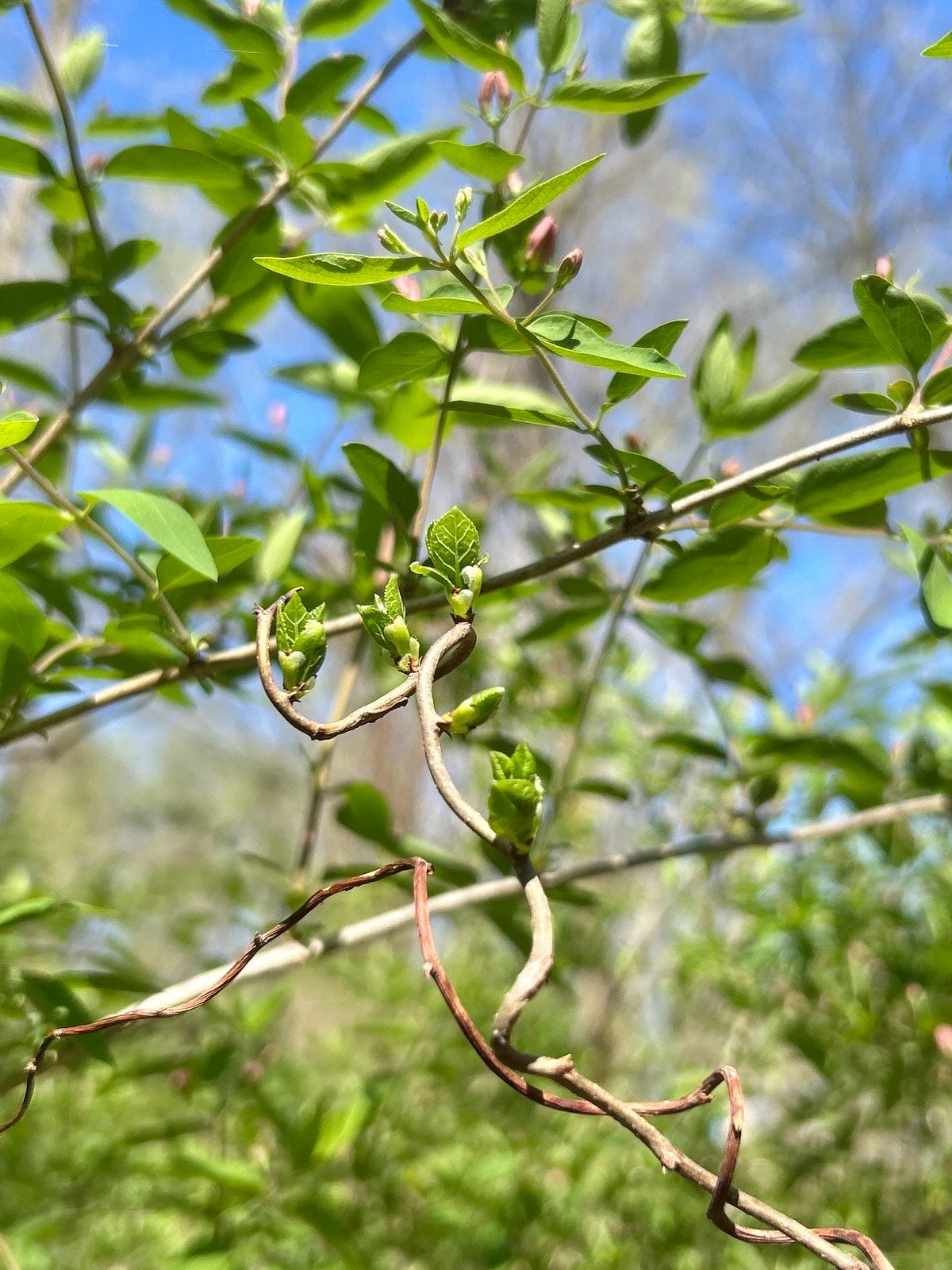
Thin, waving tendrils that brushed against my legs on the trails; dense woody thickets of sparse foliage in heavy shade; grasping, muscular vines pulling down the canopy of a small tree, bursting into dense round leaves; and, wrapped around the trunk of the tallest trees, vines six inches thick and densely scaled, vertical ridges climbing far up and around the host tree, long-since strangled to death. All of these were round leaf bittersweet. It was everywhere I looked, everywhere I took a picture. I’d never known it was there at all.
I harvest bittersweet regularly now. I make things with its vines, and I cut it back from the trees it is choking. And every time I think I understand my relationship to this plant, I find that I am wrong, missing a critical dynamic that changes everything.
Round leaf bittersweet is invasive. That is what books and scientists will tell you. And they are right. It comes from elsewhere (East Asia) and has taken over broad swaths of the North American landscape. On this continent, it has no natural biological controls. It is outcompeting and hybridizing with its native relative, American Bittersweet. And this rhetoric of invasion, no matter how accurate, makes me flinch. It is nearly impossible to speak of a being in this way without thinking of human narratives of migration, invasion, and displacement. When I walk through Fenner, folding saw at the ready, telling friends about Bittersweet’s incursion, I sound like a eugenicist.
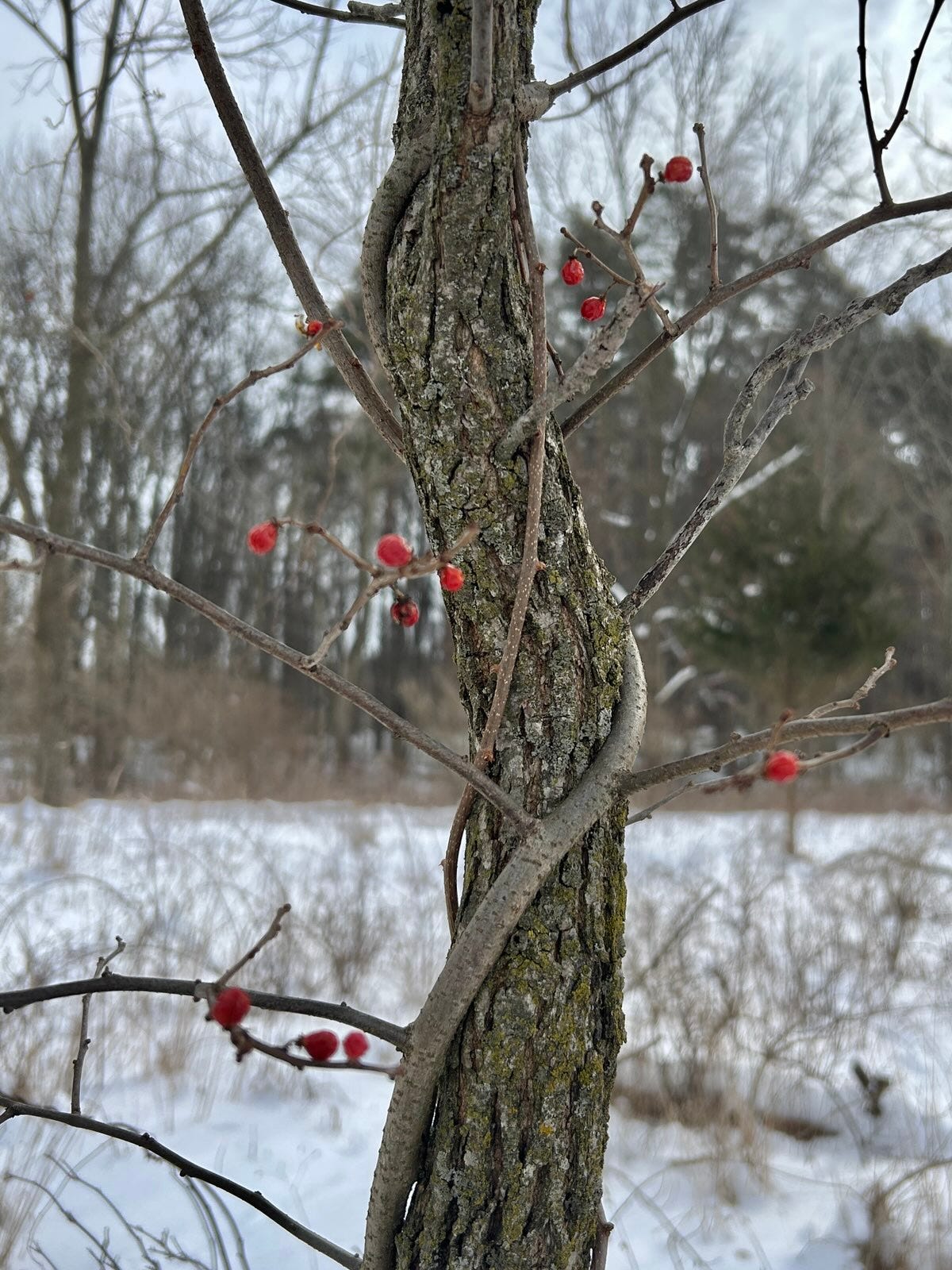
Bittersweet is the plant that has convinced me of the necessity of troubling the boundary between invasive and native species. The narrative of belonging to a place is commonly treated as static. American bittersweet is native to Eastern North America. Round leaf bittersweet is native to East Asia. But where are the hybridized progeny of these two species “from”? What of the incredible diversity of species who have been migrating between regions for millennia, through both human and more-than-human means? My old neighbor and friend, Donnie Johnson Sackey, in his new book Trespassing Natures, holds that what makes a species a settler or invader is determined “by the set of relationships - sociobiological networks – that it [is] a part of in particular environments. Thus, when we speak of invasive species, we are talking about relationships, specifically, the recognition of some connections and the absconding of others.”
Round leaf bittersweet is a trickster, morphing into whatever form its environment requires. This is not a quality exclusive to invasive species. I see it in a native vine I’ve also been battling: poison ivy. Both species love marginal, disturbed spaces. They both spread through a combination of readily-dispersed seeds and prolific underground rhizomes. They love woodland edges and other marginal environments, living on the boundaries between light and dark. They both yearn for the open sky, filling gaps in the canopy with their seeking leaves, which grow fuller, rounder, with access to the sun. Bittersweet doesn’t cause a skin reaction (at least not on my own skin). Poison ivy doesn’t strangle native trees. My reason for removing both is different, but I remove them all the same, regardless of their provenance.
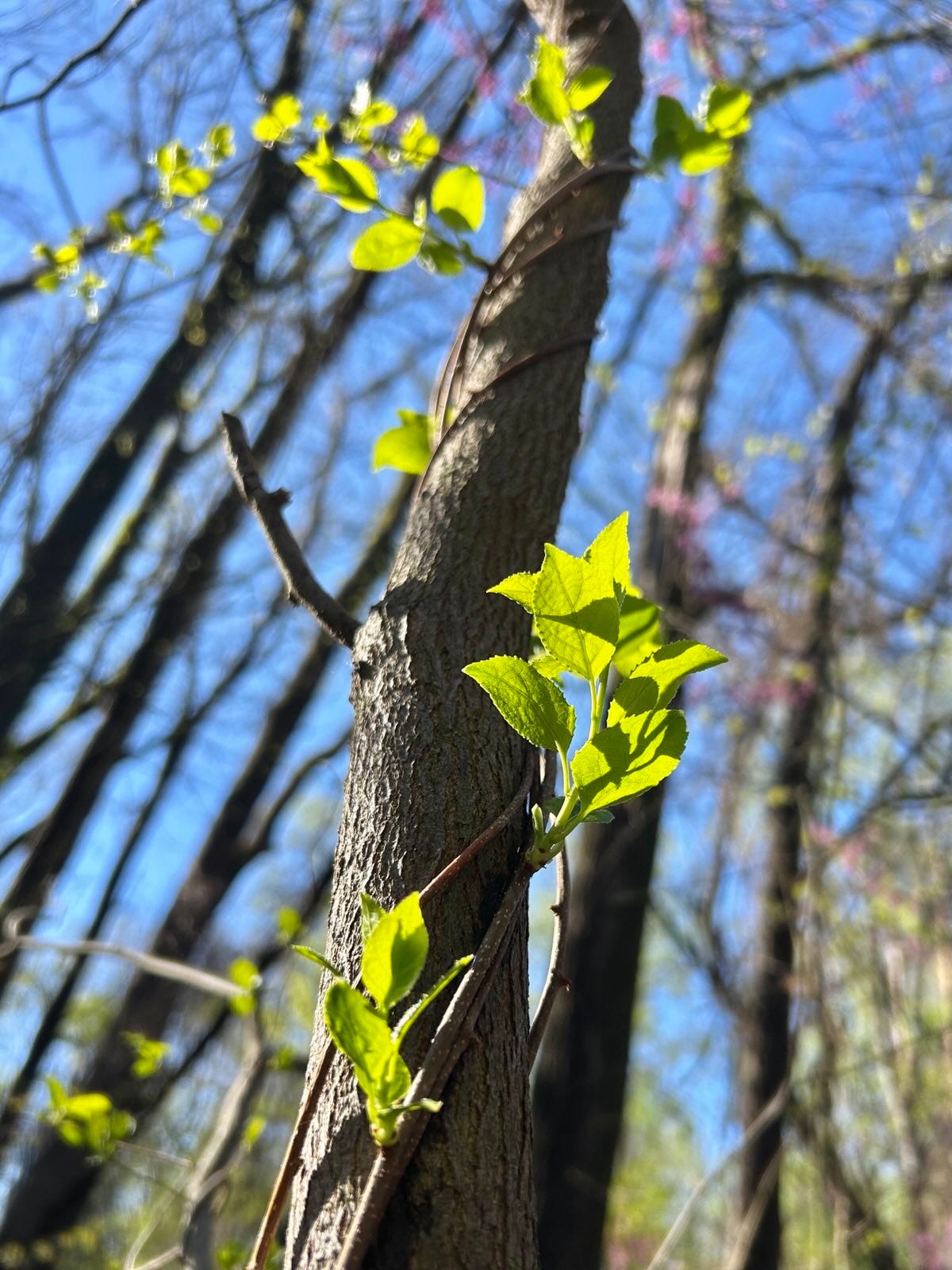
The bittersweet I’ve been harvesting is from Lansing, in the same way that I am from Lansing. We grew up in this town, surrounded by these scattered woods. We’ve never known anything else. And we’re everywhere. As I wrestled with the endless vines at Fenner earlier this spring, yanking their bright orange-red roots from the loamy soil, I saw dozens of people, settlers like me, walking along the trails. Some of them stopped to ask what I was doing. Some settler researchers, walking back to the parking lot from scouting vernal pools, stopped to thank me for my (probably futile) efforts at controlling the spread of these settler plants. But none of us belong here, not really. This place I call home had another name before it was Lansing, and another life supported by different relationships as well.
The landscape that is now Lansing once looked quite different. Nestled in the palm of Michigan’s mitten, we were a swamp before European colonization. Before Lansing was Lansing, it was Nkwejong, “where the rivers meet,” in Anishinaabemowin. It wasn’t a place of permanent settlement: it was a meeting place. An intersection of river-trails – the Grand, the Red Cedar, the Looking Glass River, Sycamore Creek, and others - where people from more habitable places could meet together. Nkwejong was once a watery world utterly unlike the city I call home.
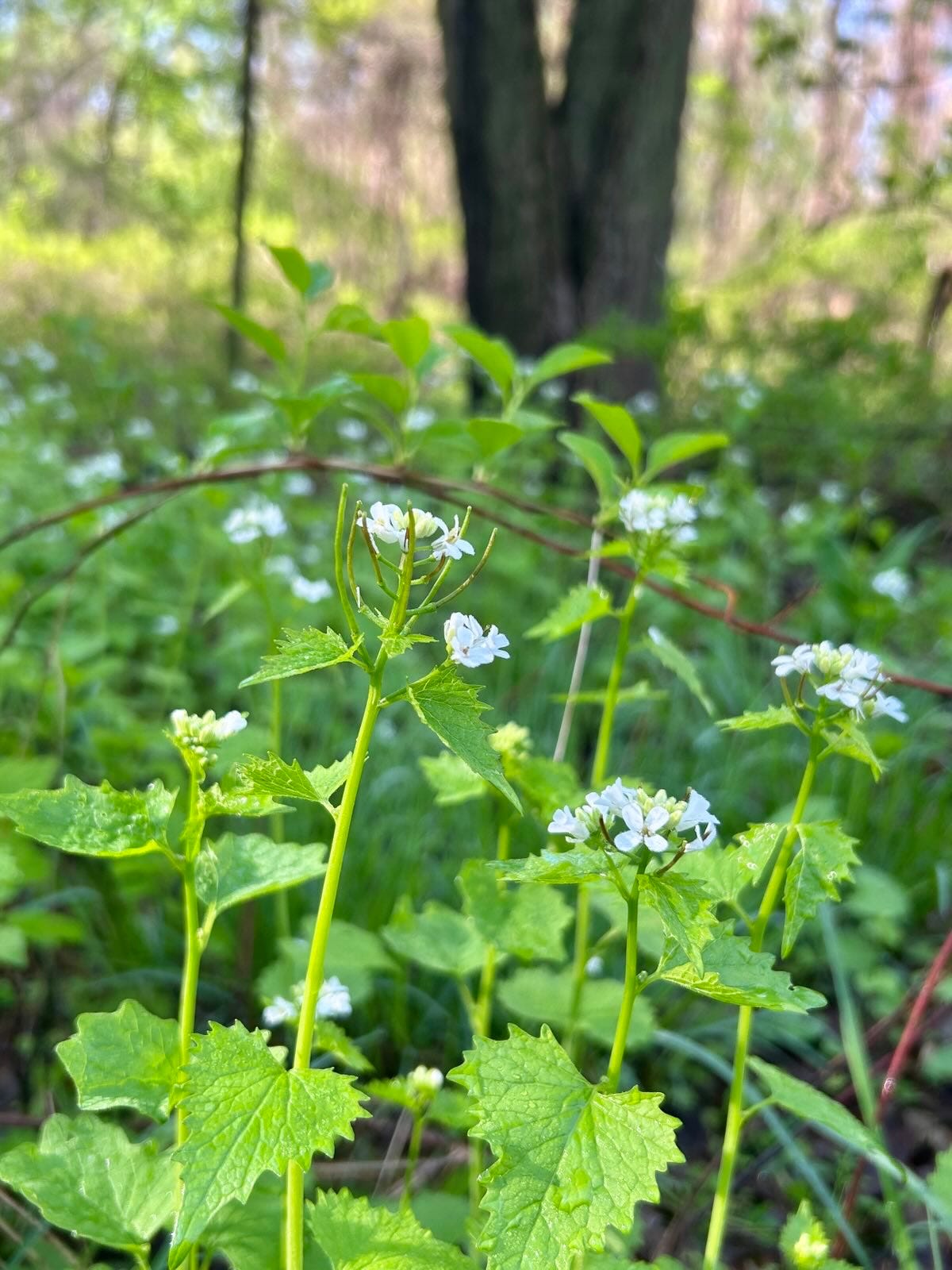
An invasive species is a settler who fundamentally changes the ecosystem to which it is introduced. Not all settler species are invasive. There are those like broad-leaf plantain, who spread abundantly and quietly, settling into existing niches without disrupting the plants and animals around them. In this nature center, which was once an arboretum, there are many introduced species who aren’t invaders: an arboretum is, in effect, a tree zoo.
The line of Osage Orange trees lining the eastern edge of the property is not native, and to my knowledge they aren’t causing any harm here. The pawpaw thicket near the marsh was planted as part of the arboretum as well. Pawpaws are technically native, if you squint. They come from the southeast, and Lansing is just north of its native range. But climate change is pushing these boundaries, and it is likely that even without deliberate planting, the Indiana Banana, as it’s known, would move northward on its own as our summers grow hotter and wetter, our winters milder. This human-assisted migration is an echo of the role Indigenous humans played in bringing the Pawpaw to the lower Midwest in the first place.
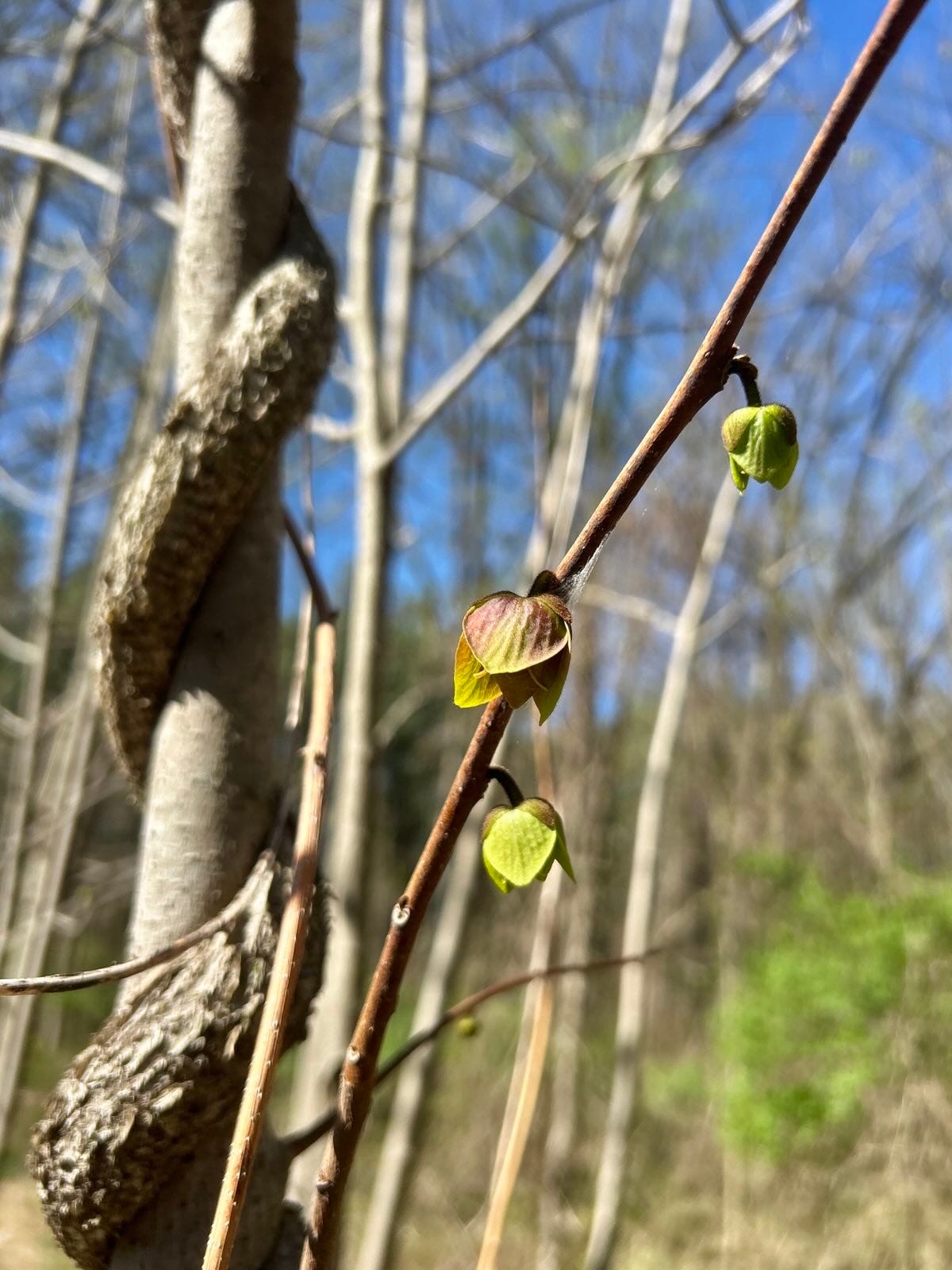
“Invasive” is not a static identity held within the body of a single being or species. To be invasive requires, as Sackey explains it, “a constellation of unbalanced relational traits between the self and others in one’s environment.” The same species that behaves as an invader in one network of relationships (such as Kudzu in the American Southeast) has entirely different relationships when it exists in a different place (such as Kudzu in Japan). Humans are a part of these constellated relationships, and in many land-based cultures, our explicit relational role is one of carefully balanced stewardship.
Settlers have divided the living world into the human and the non-human, severing the non-human world from many of its complex interspecies relationships of attention, maintenance, understanding, and care. We have removed ourselves from the complex relational webs of which we were once part. Round leaf bittersweet, when removed from its native ecosystem, emerges from its seed into a world emptied of relational responsibilities. And so, like settler humans, it invades.
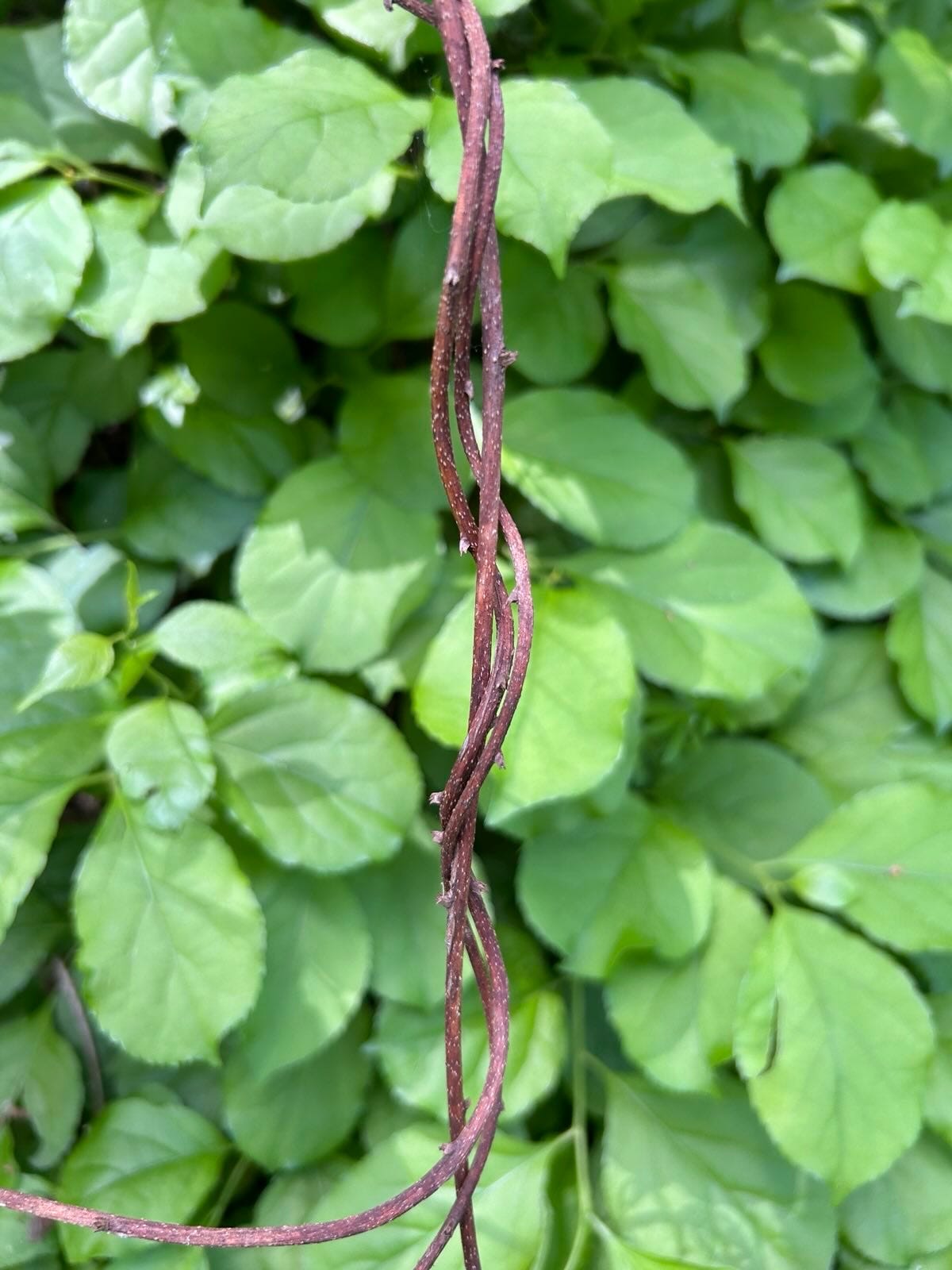
This relational neglect does not only affect non-native species. At Fenner, in the same breath that she would curse the bittersweet, the former park director used to rail against the tyranny of the whitetail deer. These, a native species, are so abundant in the park that it’s nearly impossible to visit without encountering them, almost as common as squirrels. Like round leaf bittersweet, though, whitetail deer are wildly out of balance in this tiny, microcosmic ecosystem. They eat the native foliage to the ground, leaving colonizing plants to thrive. They harbor ticks, which themselves harbor disease. They, in their unchecked abundance, suffer chronic wasting disease, infecting other deer herds.
It is not only “invasive” species which require careful attention and cautious stewardship. The deer have overpopulated the park because there is no hunting permitted anywhere nearby, and because there are no predators beyond the cars hurtling down Aurelius Road. The deer travel across the marsh to the University’s agricultural fields, feasting on the corn and soy that ruminant animals were never supposed to digest. Much like the colonizing bittersweet, much like human settlers, these native whitetail deer are born into a world of severed relationships that prevent them from the sustainable lifeways that characterized the lives of their ancestors.
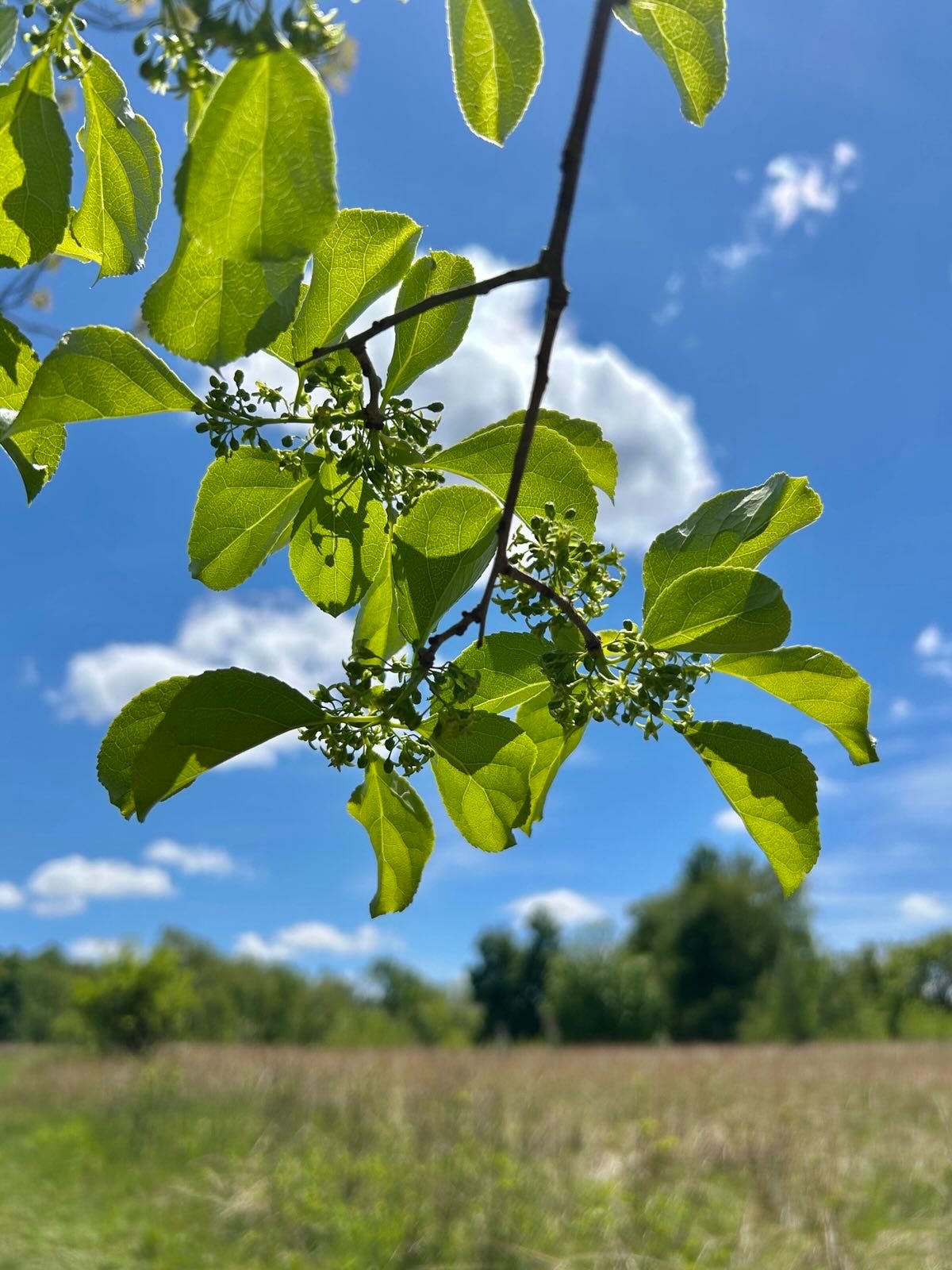
This winter, I started cutting large bittersweet vines wherever I found them. I targeted the large vines because I knew I’d never be able to keep up with the small ones. I knew, too, that leaving the smaller, more abundant vines intact meant I’d probably never be able to eradicate the bittersweet. I wasn’t even sure I wanted to eradicate it. The more I read about the false dichotomy of settler/native, the more I worried that the environmental management practices I’d learned were more a product of xenophobia (hence the common name of Oriental Bittersweet) than of responsible stewardship.
So instead of trying to kill all the bittersweet, I tried to stop the bittersweet from killing all of its neighbors. Walking in the woods throughout the winter, I brought my little folding saw, stopping regularly on the trails to cut back vines thicker than my arm, leaving them to dangle loose and heavy from the tree limbs far above. Every time I went out, I felt a complicated mix of pride and worry, glad I was doing something, but deeply uncertain about the approach I was taking.
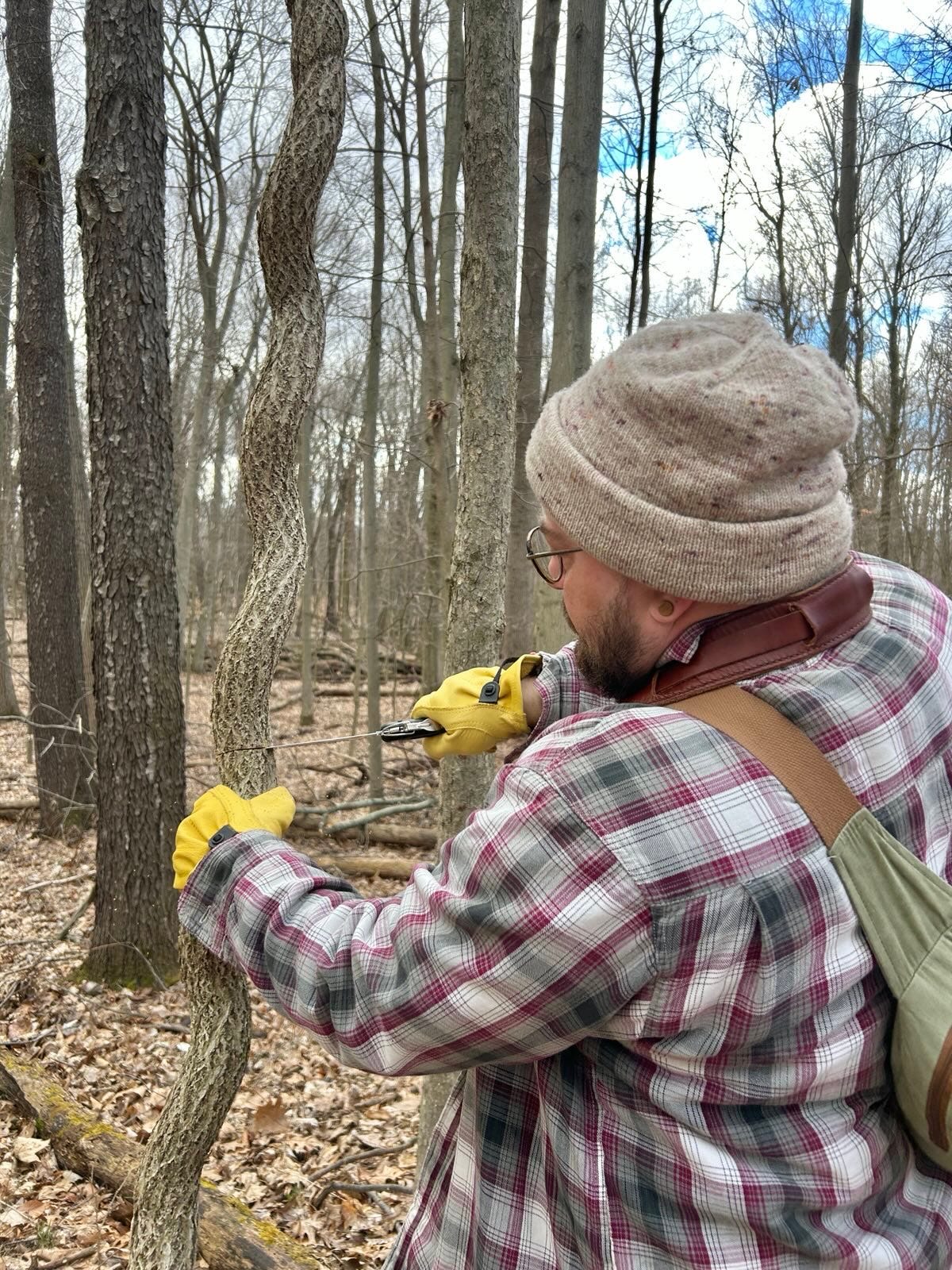
My anxiety was well-founded. A conversation with a nearby basketmaker, Michael Marie Schofield, who works extensively with invasive plants in her weaving practice, confirmed that I had no real idea what I was doing. Michael told me that she has found that cutting back large bittersweet vines encourages an explosion of new growth the following spring. Prescribed fire, too, spurs on young shoots. It seems that the only practices that successfully control round leaf bittersweet involve either complete mechanical removal or chemical defoliation. I dove into research papers, all of which prescribed contradictory methods for invasive management. I stopped cutting the big vines, but I still stare at them when I pass them in the woods, my stomach in knots. Who am I to decide what the land needs? Who am I to decide that the land doesn’t need me at all?
I, myself a settler, am twice removed from relationship to this colonizing plant. I do not possess intergenerational knowledge about bittersweet management. Bittersweet does not possess intergenerational knowledge about its own ecological niche in this new place. We are both invading the same lands. If we, Bittersweet and human settler, are both guilty of colonizing this place - of trampling and harming preexisting others without thought of relationships or consequences – then perhaps we might learn to do better by changing our relationship to one another.


Citations, recommendations, and thanks
Stacey Anne Leicht’s 2005 doctoral dissertation, "The comparative ecology of an invasive bittersweet species (Celastrus orbiculatus) and its native congener (C. scandens)"
Kurtz, Cassandra M., and Mark H. Hansen. “An Assessment of Oriental Bittersweet in Northern U.S. Forests.” Res. Note NRS-251. Newtown Square, PA: U.S. Department of Agriculture, Forest Service, Northern Research Station. 5 p., March 24, 2022.
Bousfield, Dan. “Settler Colonialism in Vegetal Worlds: Exploring Progress and Resilience at the Margins of the Anthropocene.” Settler Colonial Studies 10, no. 1 (2020): 15.
Trespassing Natures by Donnie Johnson Sackey
As We Have Always Done by Leanne Betasamosake Simspon
Braiding Sweetgrass by Robin Wall Kimmerer (in particular, chapter 18, “In the Footsteps of Nanabozho”)
Thanks to Michael Marie Schofield for the bittersweet wisdom.
Thanks to bittersweet, for all you’ve taught us.
 | A guest post by
|